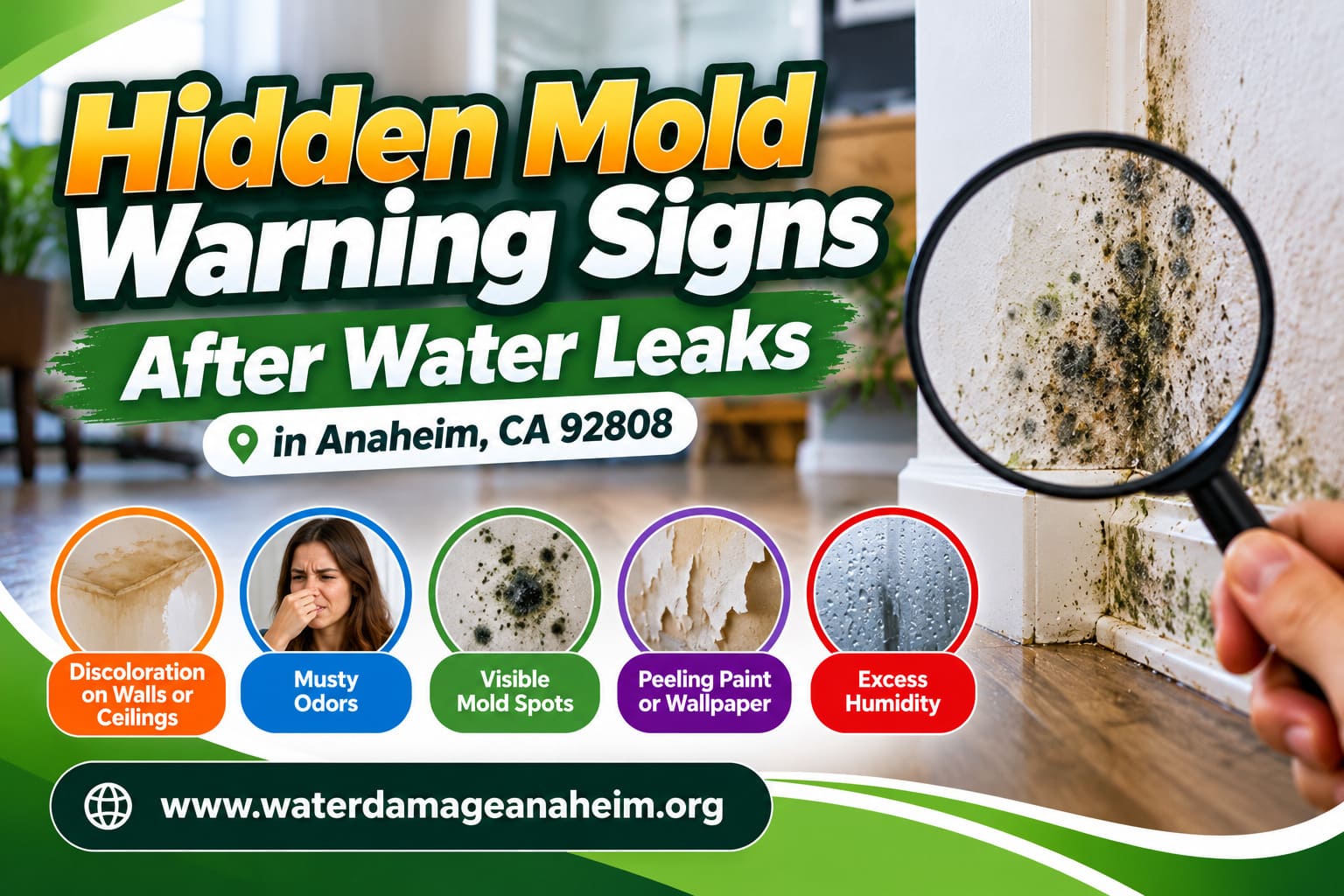
Hidden Mold Warning Signs After Water Leaks in Anaheim, CA 92808
Of all the problems that follow water damage in an Anaheim CA 92808 home, hidden mold is among the most insidious. It does not always announce itself visibly. Mold can colonize the inside of walls, under bathroom tile, beneath laminate flooring, inside HVAC ductwork, and above ceiling tiles long before it becomes visible on any surface you can actually see. By the time you notice a stain or discoloration, a serious mold problem may have already been developing for weeks.
This guide walks Anaheim homeowners through the most important warning signs of hidden mold growth following water leaks, appliance failures, storm intrusion, and plumbing issues. Recognizing these signs early is the best thing you can do to protect both your home's structure and your family's health.
If you suspect mold in your home, do not wait for confirmation before calling for help. Water Damage Anaheim provides professional mold remediation services throughout Anaheim, CA 92808. Reach us 24 hours a day at (714) 228-5676.
"Mold is patient. It does not need sunlight, it does not need much food, and it grows in places you cannot see. Knowing what to look for is the only reliable defense homeowners have."
Water Damage Anaheim Team
Why Anaheim CA 92808 Homes Are Susceptible to Mold
Anaheim's climate creates favorable conditions for mold growth. Warm temperatures combined with seasonal humidity, periodic heavy rains, and the residual moisture that lingers after plumbing events create an environment where mold can thrive. Homes in the 92808 zip code, particularly those built in the 1970s through 1990s, often have older plumbing and building materials that are more susceptible to water intrusion and mold development.
- Anaheim Hills properties with canyon-facing exposures can experience higher humidity levels from marine layer intrusion during certain seasons.
- Homes with older plumbing systems have higher rates of slow leaks behind walls that go undetected for extended periods.
- Tile grout and caulk in older bathrooms often deteriorates, allowing moisture to penetrate behind tiles and into wall cavities.
- Homes with flat or low-sloped roofs, common in some Anaheim neighborhoods, are more prone to storm water ponding that can lead to attic moisture and mold.
Warning Sign 1: A Persistent Musty or Earthy Smell
This is often the first and most reliable warning sign of hidden mold. Mold produces metabolic byproducts called microbial volatile organic compounds, or mVOCs. These compounds create the distinctive musty, earthy, damp smell that most people associate with old basements or water-damaged spaces. If you notice this odor in your Anaheim home and cannot identify a visible source, hidden mold is almost certainly the cause.
- The smell may be stronger near specific walls, under sinks, around HVAC vents, or in bathrooms and laundry areas.
- The odor may intensify after running air conditioning or heat, as the system circulates air through affected ductwork.
- If the smell disappears when windows are open but returns when the home is closed up, it strongly suggests an indoor mold source.
- Trust your nose. If the smell does not go away despite cleaning, call for a professional mold inspection.
Warning Sign 2: Unexplained Health Symptoms
One of the most under-recognized warning signs of hidden mold is when family members begin experiencing health symptoms that improve when they leave the home and return when they come back. Mold spores are microscopic and travel through the air in your home, landing in respiratory passages with every breath.
- Persistent nasal congestion, runny nose, or post-nasal drip that does not respond to typical allergy treatments.
- Coughing, sneezing, or throat irritation that is worse at home than elsewhere.
- Itchy or red eyes, particularly noticeable in the morning after sleeping in a mold-affected room.
- Skin rashes or hives without a clear cause.
- Frequent headaches, fatigue, or difficulty concentrating, especially in individuals with no prior history of these issues.
- Worsening asthma or allergy symptoms in family members who previously had well-controlled conditions.
Children, elderly family members, and anyone with a compromised immune system are most vulnerable to health effects from mold exposure. If these symptoms align with your household's experience, a mold inspection should be a top priority.
Warning Sign 3: Visible Staining or Discoloration on Walls and Ceilings
Mold growth that has reached the surface of drywall, plaster, or ceiling materials produces visible staining. However, the staining you see is often the outer edge of a much larger hidden colony. Common visible indicators include:
- Yellow, brown, or gray stains on drywall or plaster, particularly near where walls meet floors, ceilings, or adjacent bathrooms.
- Dark spots or streaks that appear in clusters rather than as a uniform stain pattern.
- Black or green discoloration in grout lines in bathrooms and kitchens.
- White or fuzzy growth on basement walls, damp crawl spaces, or around window frames.
- Staining on ceiling tiles directly below bathrooms on upper floors.
Any visible mold stain on a finished surface indicates that moisture has penetrated into or through that surface material. The visible growth is not the whole problem. Professional assessment is needed to determine how far the growth extends into the wall or ceiling cavity.
Warning Sign 4: Peeling, Bubbling, or Warping Paint and Wallpaper
Paint and wallpaper that begins to peel, bubble, or warp without an obvious external cause is a strong indicator of moisture behind the surface. As mold grows within or just behind the drywall, it increases local humidity that causes adhesion to fail between the wall surface and its finish coating.
- Bubbling paint on interior walls, especially near plumbing fixtures or exterior walls.
- Wallpaper lifting at seams or edges, particularly in bathrooms, laundry rooms, and kitchens.
- Paint that repeatedly peels in the same spots even after repainting suggests ongoing moisture intrusion.
- Soft spots in drywall beneath paint, which indicate the paper face of the drywall has been degraded by moisture and mold.
Warning Sign 5: Warped, Buckled, or Soft Flooring
Flooring that warps, buckles, separates at seams, or develops soft spots is a sign that moisture has penetrated beneath the surface. This is especially common in Anaheim CA 92808 homes with laminate flooring, hardwood, or engineered wood that are sensitive to moisture. Mold growth in the subfloor is a serious structural issue that requires professional remediation.
- Laminate or hardwood floor boards that have lifted at the edges, creating ridges along board seams.
- Soft or spongy areas when walking across a previously solid floor.
- Tile floors where individual tiles have become loose, hollow-sounding, or cracked at grout lines without impact damage.
- Carpet that smells musty even after cleaning, or that has developed stains at the edges near walls.
Warning Sign 6: Condensation on Windows or Cold Surfaces
Persistent condensation on windows, cold pipes, or exterior walls indicates elevated indoor humidity. While condensation itself is not mold, it creates the conditions that allow mold to develop on and around those surfaces. Condensation on window frames, sills, and adjacent walls is a common precursor to mold growth in those areas.
- Windows that regularly fog up on the interior surface, especially during cooler months.
- Water droplets on exposed cold water pipes, particularly in under-sink cabinet areas.
- Condensation on exterior walls in rooms with poor ventilation.
- Frost or ice buildup in attic spaces adjacent to poorly insulated areas where warm moist air meets cold surfaces.
Warning Sign 7: A History of Water Leaks or Past Flooding
Any home in Anaheim CA 92808 that has experienced a past water leak, plumbing failure, appliance overflow, or storm flooding that was not professionally dried should be considered at elevated risk for hidden mold. If you purchased your home and are not certain of its water damage history, a professional mold inspection is worthwhile as a baseline.
- Previous owners may have painted over mold staining to conceal it during a home sale.
- Water damage that was cleaned up with consumer equipment often leaves residual moisture inside walls and subfloors that can harbor mold.
- Appliance leaks that were wiped up on the surface but not professionally dried may have significant hidden mold beneath and behind the appliance.
- Homes with a history of roof leaks, particularly around skylights, chimneys, or valleys, often have attic mold that spreads downward over time.
Where Mold Hides Most Often in Anaheim CA 92808 Homes
Based on our experience with mold remediation across the 92808 zip code, here are the most common locations where hidden mold is found:
- Behind bathroom tiles: Failed caulk and grout allow shower water to seep behind tiles repeatedly over time.
- Under kitchen sinks: Slow drainpipe leaks and supply line drips create persistently damp cabinet bottoms.
- Behind washing machines: Even small hose drips build up significant mold over weeks in an enclosed laundry space.
- Inside HVAC ducts and air handlers: Condensation inside ductwork from improper insulation or oversized systems creates mold that then blows through the entire home.
- In attic spaces: Poor ventilation, roof leaks, and bathroom exhaust fans venting into the attic rather than outside are primary causes of attic mold.
- Beneath bathroom flooring: Water that seeps through grout in shower surrounds or around toilet bases collects under tile and in the subfloor below.
- Inside walls near exterior pipes: In Anaheim Hills homes with concrete slab foundations, pipes running through slabs or exterior walls are common leak points that go undetected for extended periods.
- In crawl spaces: Ground moisture, poor vapor barrier coverage, and inadequate ventilation make crawl spaces one of the highest-risk areas for mold development in Anaheim CA homes.
What to Do If You Suspect Hidden Mold
If you are noticing any of the warning signs described in this guide, take the following steps:
- Do not disturb the area. Attempting to clean or remove suspected mold without proper containment can spread spores throughout your home.
- Call for a professional inspection. Water Damage Anaheim can assess your Anaheim CA 92808 home for moisture and mold using professional-grade moisture meters, hygrometers, and, where appropriate, infrared thermal imaging to identify hidden wet areas.
- Address the moisture source first. Mold remediation without fixing the underlying leak or moisture problem will result in mold returning. Our team identifies and addresses the moisture source before remediation begins.
- Consider air quality testing. In homes where health symptoms are present, air quality testing for mold spore counts can help determine the extent of the problem and verify remediation effectiveness.
- Do not paint over mold. Painting over mold staining conceals the problem temporarily but does not kill the mold, which will continue growing behind the new paint layer and eventually return to the surface.
The Mold Remediation Process From Water Damage Anaheim
When you call Water Damage Anaheim for mold remediation in your Anaheim, CA 92808 home, here is how the process works:
- Moisture mapping and assessment: We identify all affected areas using professional moisture detection equipment, including areas not visually apparent.
- Containment setup: We establish negative pressure containment zones around affected areas to prevent spore migration to clean parts of the home during remediation.
- Personal protective equipment: Our technicians wear full protective gear including respirators and gloves to safely handle contaminated materials.
- Mold removal: Affected porous materials such as drywall, insulation, and wood that cannot be cleaned are removed and safely disposed of.
- HEPA vacuuming and cleaning: All surfaces in the containment zone are HEPA vacuumed and cleaned with EPA-registered antimicrobial solutions.
- Air scrubbing: Commercial HEPA air scrubbers run continuously during and after remediation to remove airborne spores from the work area.
- Clearance testing: Post-remediation testing verifies that mold levels have returned to acceptable levels before containment is removed.
- Structural drying: Any remaining moisture in structural materials is dried using commercial air movers and dehumidifiers to prevent recurrence.
After remediation is complete, reconstruction of any removed drywall, flooring, or other materials can begin. Water Damage Anaheim can coordinate the full scope of work or work alongside your preferred contractor for the rebuild phase.
Frequently Asked Questions About Hidden Mold in Anaheim CA 92808
Can a small water leak really cause serious mold?
Yes. A slow drip inside a wall or under a sink, left unaddressed for weeks or months, can generate massive mold colonies. The amount of water required is far less than most homeowners expect. Even a small refrigerator ice maker line leak can create significant mold growth behind cabinetry in a matter of weeks.
My home looks fine. How do I know if there is hidden mold?
The most reliable way to detect hidden mold without visible signs is through a professional inspection using moisture meters and thermal imaging, combined with air quality sampling. If you have had any water damage event in the past year and it was not professionally dried, a mold inspection is strongly recommended.
Will my homeowner's insurance cover mold remediation?
This depends on the cause of the mold. If mold results from a sudden covered event like a burst pipe, many policies will cover at least partial remediation costs. Mold from long-term neglect or gradual leaks is typically excluded. Check your policy and call your insurance agent to discuss your specific situation.
How can I prevent mold from growing back after remediation?
Mold prevention comes down to controlling moisture. Fix all leaks promptly, use bathroom exhaust fans consistently during and after showers, maintain your HVAC system regularly, keep indoor humidity below 50%, and schedule regular inspections of known moisture-prone areas. After remediation, Water Damage Anaheim will provide you with specific recommendations for your Anaheim CA 92808 home.